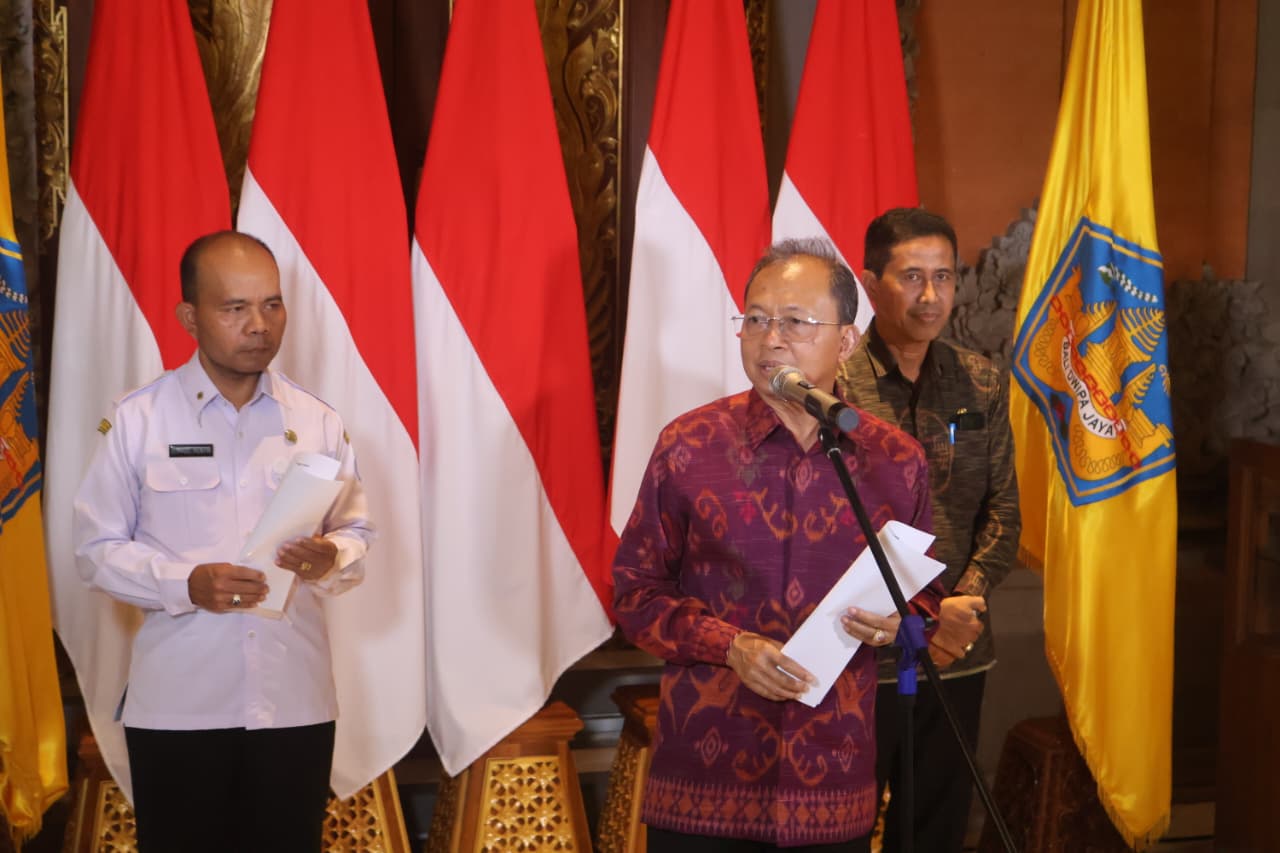
DENPASAR — Bali Governor Wayan Koster welcomed the working visit of Deputy Minister for Housing and Settlement Areas of Indonesia, Fahri Hamzah, at the Kertha Sabha Building, Jayasabha, Denpasar, on Friday (October 3). The meeting focused on addressing uninhabitable houses (RTLH), slum settlements, and the design of Bali’s urban and rural areas in line with the national development vision toward Indonesia Emas 2045.
Governor Koster reported Bali’s condition following recent severe floods, triggered by the heaviest rainfall in 70 years caused by the equatorial Rossby storm. Assistance from the central, provincial, and regency/city governments has already been distributed, with IDR 15 million allocated to each affected household. Traders at Badung Market who lost merchandise received compensation amounting to IDR 3.4 billion, based on turnover data from market management. Additional aid exceeding IDR 1 billion has also been distributed to flood victims in Tabanan and Jembrana.
“All damaged homes have been handled, while roads and bridges are under repair. Moving forward, we will audit four major rivers for reforestation and restructuring. Stronger disaster mitigation is a must,” Koster said.
On housing, the Governor revealed that Bali currently has 33,086 uninhabitable homes, with the highest number in Karangasem Regency. The government aims to resolve all RTLH cases by 2029 through collaboration between the national budget (APBN), provincial and regency/city budgets, as well as CSR contributions and civil servant community initiatives.
“The APBN will support more than 12,000 housing units, while the province will channel Special Financial Assistance (BKK) to regencies and cities, especially six areas with weaker fiscal capacity,” Koster explained.
He also highlighted Bali’s strengths: strong traditional villages, an economy above the national average, the lowest poverty and unemployment rates in Indonesia, the fifth-highest Human Development Index (HDI), the nation’s highest life expectancy, and the lowest stunting prevalence.
Nevertheless, he pointed out challenges, including fiscal disparities between regions, the conversion of 700 hectares of land annually, increasing traffic congestion, and worsening waste issues in line with growing tourism flows.
“Tourism contributes 66 percent of Bali’s economy but remains highly vulnerable to disasters and security issues. That is why we are designing an economic transformation that ensures Bali can thrive with or without tourism,” Koster added.
Deputy Minister Fahri Hamzah described Bali as both the heart of national growth and Indonesia’s showcase to the world. Housing and settlements in Bali, he said, must reflect international standards.
“Tourism is the most distributive and democratic industry because it spreads prosperity directly to the people. With 6.5 million international tourists, Bali is Indonesia’s face. Therefore, housing and settlement design here must be integrated, modern, and at the same time respect local culture,” Fahri noted.
He explained that the ministry targets the renovation of 400,000 homes nationwide, aiming to scale up to 1 million. In Bali, priority will be given to eliminating uninhabitable homes starting in 2026, along with restructuring 12 km² of slum areas near rivers and coastal zones.
“Bali’s coastline must shine like the Maldives—modern fishing villages that are hygienic and tourism-friendly,” he said.
Fahri also stressed the importance of multi-story housing in urban areas to preserve arable land. “Bali’s cultural rule on building height must be respected. However, we can adapt two- to three-story housing concepts for subsidized residential areas,” he emphasized.
Toward 2029: A Bali Without Uninhabitable Homes
In closing, Governor Koster reiterated that the 100-Year Bali Development Plan will serve as the island’s long-term guide, addressing land conversion control, foreign tourist quotas, and land consolidation in densely populated areas.
“If housing allocations can be increased in 2026, we are optimistic that uninhabitable homes in Karangasem, Gianyar, Jembrana, and Bangli can be resolved sooner. Bali must truly represent Indonesia at its best,” Koster concluded.***