

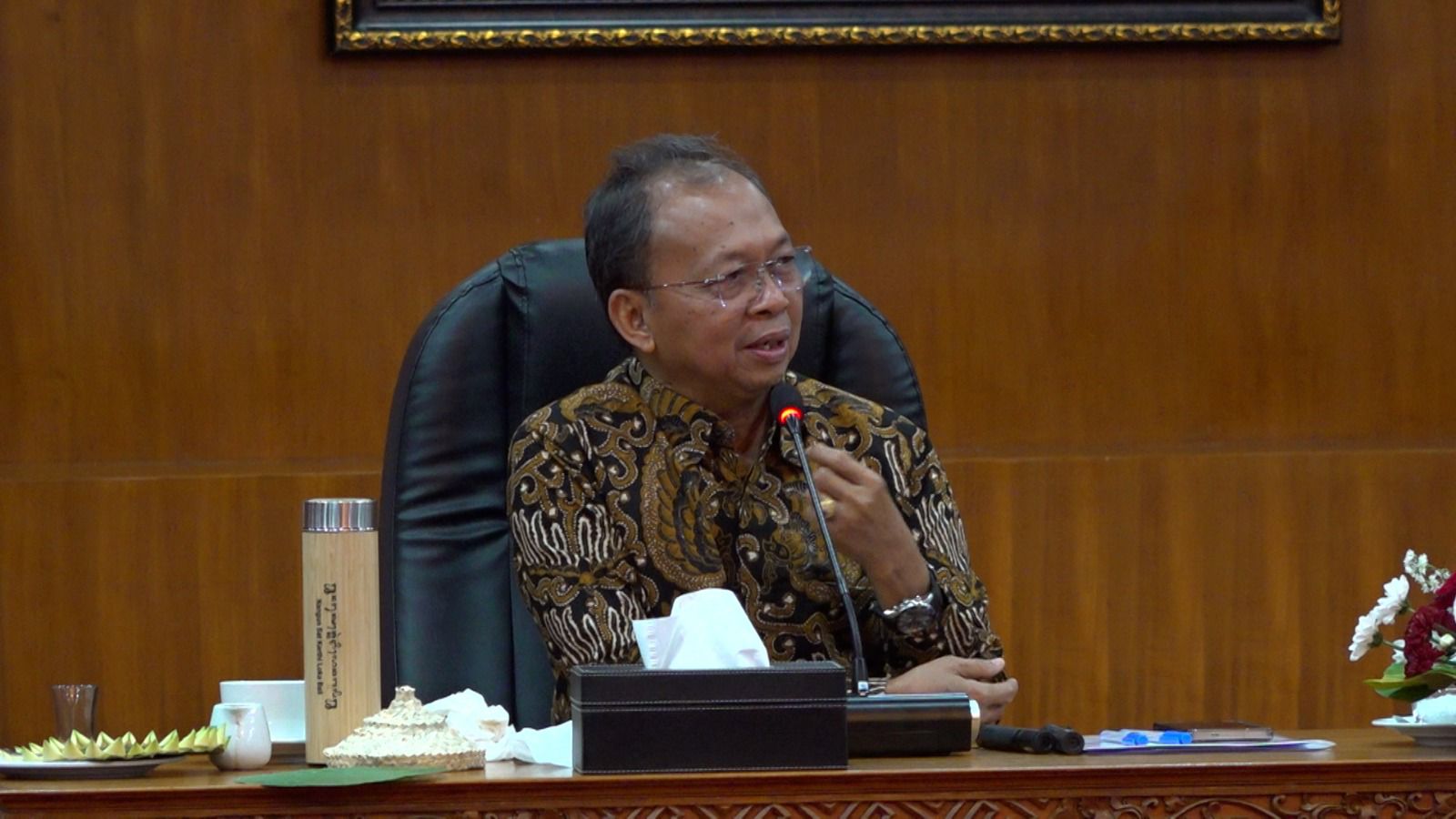
DENPASAR — The Bali Provincial Government continues to accelerate the adoption of electric vehicles (EVs) and the development of an integrated e-mobility ecosystem as part of its clean energy transition and efforts to position Bali as a pioneer of the green economy. The policy also aims to support high-quality and sustainable tourism on the island.
This was conveyed by Bali Governor Wayan Koster during a meeting on the acceleration of electric vehicle adoption with PT PLN (Persero) Director of Retail and Commerce, Adi Priyanto, held at the Kertha Sabha Meeting Room, Jayasabha— the Governor’s Official Residence—on Saturday (24/1).
The meeting followed up on an initial discussion regarding the development of Bali’s EV ecosystem, which took place on December 26, 2025, involving the Bali Provincial Government, PLN, and representatives of automotive brand holders (ATPM).
During the meeting, Governor Koster reiterated that electric vehicles are significantly more efficient, energy-saving, quieter, and emission-free. These characteristics, he said, align with Bali’s development vision Nangun Sat Kerthi Loka Bali, which emphasizes preserving the sanctity and harmony of Bali’s natural environment to achieve a prosperous and harmonious life—sekala-niskala.
“This plan has been envisioned for quite some time but was delayed due to the COVID-19 pandemic. Now that the economy has improved, the electric vehicle program can be implemented. This policy is part of the Nangun Sat Kerthi Loka Bali vision—maintaining the purity and balance of Bali’s environment to ensure the well-being and happiness of the Balinese people, both physically and spiritually,” Governor Koster said.
Governor Koster stated that Bali is targeting a pioneering role in the electric vehicle industry, encouraging both government officials and the general public to transition to battery-based vehicles.
“This initiative can be mobilized and accelerated. We can begin by establishing initial EV zones in Ubud, Sanur, Kuta, Nusa Dua, and Nusa Penida. Nusa Penida, in particular, will be developed as a green island. The Regent of Klungkung has expressed full readiness and support for this policy,” he explained.
To support this initiative, Governor Koster emphasized the need for adequate public EV charging infrastructure (SPKLU). He also highlighted the importance of continuous public campaigns involving community participation, as well as promotional events that engage government institutions, businesses, and EV users.
“By using electric vehicles, people can be more efficient and economical. There is no need to purchase fuel or change engine oil, and maintenance requirements are much simpler,” he added.
Echoing the Governor’s remarks, PLN Director of Retail and Commerce Adi Priyanto said that electric vehicles offer significant benefits to users, particularly in reducing daily operational costs due to lower electricity charging expenses compared to fossil fuels and simpler vehicle maintenance. EV users also enjoy a quieter driving experience, instant acceleration, and zero emissions.
Adi further affirmed PLN’s commitment to ensuring a reliable electricity supply to support industrial, business, and household activities, thereby enhancing productivity and competitiveness to drive national economic growth. He noted that EV infrastructure development has been incorporated into PLN’s Electricity Supply Business Plan (RUPTL) and Corporate Long-Term Plan (RJPP).
“PLN is committed to significantly expanding charging infrastructure through continuous innovation, positioning itself as the epicenter of an integrated EV ecosystem via the PLN Mobile application. This allows EV users to enjoy greater convenience through features such as Trip Planner to locate charging stations, AntreEV for transparent queue reservations, and a 24/7 SPKLU service hotline to ensure a seamless charging experience,” Adi explained.
To accelerate the EV ecosystem, PLN also supports various incentive programs, including discounts for EV users through Home Charging Services, as well as incentives for charging infrastructure providers, such as SPKLU, SPBKLU, and private electrical installations for public transportation fleets.
“As the number of electric vehicles in Bali continues to increase, EV users are increasingly relying on home charging for daily needs. Meanwhile, PLN is strengthening SPKLU as the backbone of charging infrastructure, particularly in tourist destinations and long-distance travel corridors, to support Bali’s high-mobility tourism character. Acceleration from the Bali Provincial Government is therefore essential,” he added.
Adi also revealed that the number of electric vehicles in Indonesia has grown by an average of 2.5 times annually over the past three years, reaching approximately 175,000 units by 2025. This growth has been driven by government incentives for manufacturers and users, as well as the increasing availability of EV brands at more competitive prices.
“In Bali Province, EV energy consumption is dominated by home charging, accounting for 55 percent (2.24 GWh), while public charging stations contribute 45 percent (1.82 GWh). This pattern shows that home charging serves daily needs, while SPKLU plays a strategic role in supporting mobility and tourism. Balanced development of both is key to sustaining Bali’s EV ecosystem,” he concluded. (*)


