

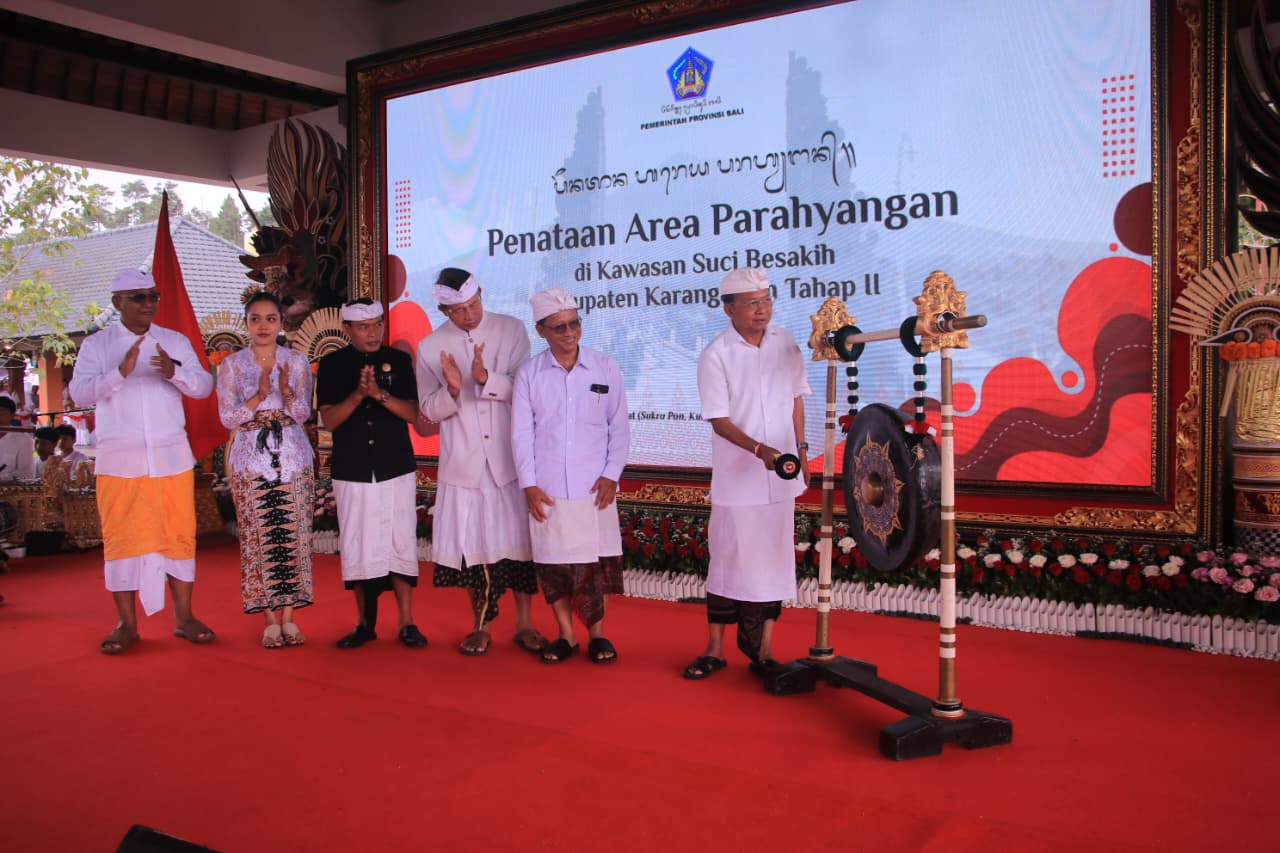
KARANGASEM — Bali Governor Wayan Koster has officially launched a major restoration initiative long in the making: the revitalization of the Parahyangan (sacred temple zone) at Pura Agung Besakih, the spiritual center of Balinese Hinduism and a key axis in the island’s cosmology.
The sacred milestone was marked by the Ngeruak/Mulang Dasar ceremony and the groundbreaking of Phase II of the Parahyangan restoration works at Pura Banua, Besakih, Rendang, on Friday (May 1), coinciding with the full moon (Purnama).
Speaking before attendees at Wantilan Kesari Warmadewa Besakih, Koster emphasized that the initiative is not merely a construction project, but a comprehensive restoration aimed at preserving the temple’s original architectural identity and spiritual essence.
“This is not new construction, nor a simple renovation. This is restoration—rebuilding while preserving authenticity,” he stated.
From Disorder to Sacred Harmony
The restoration addresses decades of structural inconsistency across the temple complex. Variations were found in candi bentar gates, boundary walls, and shrines (pelinggih), including differences in materials, colors, ornaments, and proportions.
Building materials ranged from sandstone and red brick to mixed concrete, often with uneven quality. Some structures had deteriorated, showing signs of aging and neglect.
“Overall, the area lacks harmony and does not reflect the grandeur of a sacred complex set against Mount Agung,” Koster noted.
He explained that the condition resulted from the absence of standardized guidelines, with development historically depending on local government capabilities and community contributions.
Through this restoration, a total of 30 sacred structures—26 within the main Besakih complex and four affiliated temples—will be reorganized based on key principles: restoring original Balinese architectural standards, using uniform high-quality materials, and aligning ornaments with traditional designs.
The goal is not only aesthetic improvement but also the restoration of harmony in both the physical (sekala) and spiritual (niskala) realms.
A Rp1 Trillion Project: From Infrastructure to Spiritual Core
The Parahyangan restoration represents the second phase of the broader Besakih development. The first phase focused on palemahan (outer areas), including parking facilities, worshiper amenities, and vendor spaces.
Total investment for the overall project exceeds Rp1 trillion (over USD 60 million), with Phase I costing around Rp911 billion—funded by both the national budget (APBN) and Bali’s regional budget (APBD). Phase II, initiated in 2025, continues with additional funding through 2026.
Koster highlighted that one of the most tangible improvements has been access and parking management.
“In the past, it was extremely congested. Vehicles piled up, and worshippers couldn’t even enter the temple—some had to pray from the roadside,” he recalled.
Today, centralized parking and improved traffic management have significantly reduced congestion during major religious ceremonies.
More Than Construction: A Spiritual Endeavor
Koster stressed that the restoration must be approached with spiritual awareness.
“This is the sacred abode of the deities. It must be carried out with devotion and prayer, not just technical execution,” he said.
He urged contractors to begin and end their work with prayers, emphasizing that quality must not be compromised.
“Do not focus only on profit. If quality is reduced, the results will not be good. This is a sacred site, not an ordinary project,” he asserted.
Preserving Heritage for Future Generations
Beyond infrastructure, the project reflects a deeper commitment to preserving Bali’s spiritual heritage.
Koster described Besakih as an integral part of Bali’s cosmological system, linked to concepts such as Madya Ning Bhuwana, Padma Bhuwana, and Kahyangan Jagat.
“Bali is not ordinary land. It is sacred ground sanctified by our ancestors. We are merely continuing what they began,” he said.
He emphasized the responsibility of the current generation to protect and enhance this legacy for the future.
Next Phase: Integrated Access Development
Looking ahead, the government is preparing Phase III, focusing on improving access routes to Besakih from Bangli, Singaraja, Karangasem, and Klungkung.
The plan includes:
- 2027: Planning and detailed engineering design
- 2028: Construction
- 2029: Completion
This integrated system aims to create a seamless, safe, and spiritually meaningful journey for worshippers.
For Bali, Indonesia, and the World
Koster concluded by underlining the broader significance of the project.
“This is not only for Bali, but for Indonesia and the world,” he said.
With Phase II targeted for completion in November 2026, the restoration marks a major milestone in revitalizing Pura Agung Besakih as a living spiritual center—physically and metaphysically.
A monumental effort not just to rebuild, but to restore the sacred essence of Bali’s enduring civilization.***


